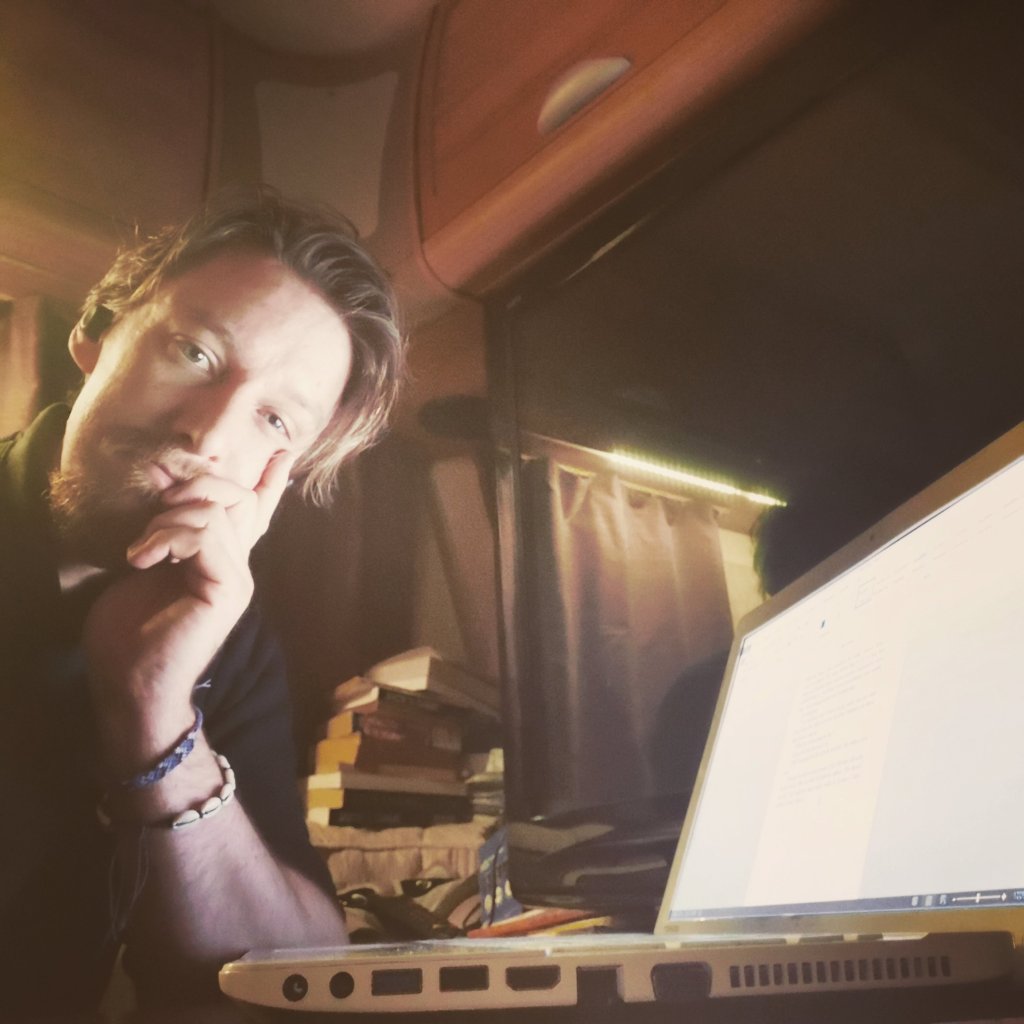
5am is a good time to write. Blue Pulp is getting exciting. The western is an underestimated genre. When you strip everything out, all the things that distract us in the modern world, so all you have is the man and his thoughts, you can get deep and frightening with the human condition.
I know you can’t buy any of these books yet but soon you’ll be able to. This is book three and I’ve got one more to write. I think I’ll be done by spring.
I was reading a western last night. A slim novella. Less that 200 pages. There is something engaging and lively in the telling of a shorter novel. Something I embrace in my own writing.
I can wait for you to read this. If you’ve never read a western before maybe it’s time to try it out.
I’ll be posting covers and release dates right here over the next few months.
One day this period that we are living in will be the subject of historical fiction. Our Instagram, electric cars, and smart phones will seem like medieval devices. We will seem backwards in our dress and old-fashioned in our thinking. People will think the 2020s were populated by small-minded simpletons, that the people were afraid of science and new ideas, that the governments were stuffy and the class divide was great.
I write westerns under the name, Elwood Flynn (they will be published next year, but you can find Elwood on Instagram if you are interested in following that journey) and so I spend a lot of time thinking about how people thought back then.
It is easy to write two dimensional flat characters, stereotypical and slightly less intelligent than our far superior future selves. To write engaging real people in historical fiction you have to keep in mind one very important thing: Every person who has ever lived believed that they were living in the most modern times in all of history.
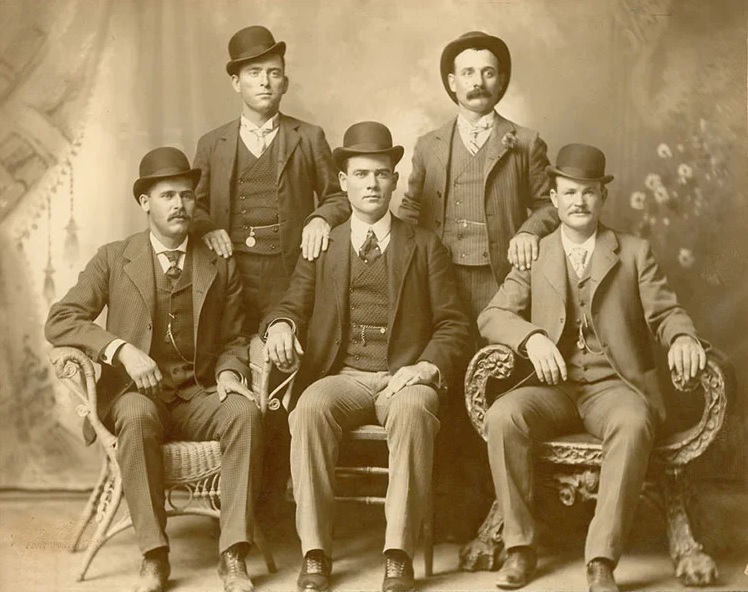
Cowboys photographed in grainy photographs in the late 1800s, in bowler hats and waistcoats; how old-fashioned their minds must have been. But even though these were gunslingers in a lawless land, they were wearing the highest Victorian fashion of the time, dressed like the British upper-class. Even outlaws were trendy, just not to us, not now.
Butch Cassidy’s Wild Bunch were some well-dressed dudes.
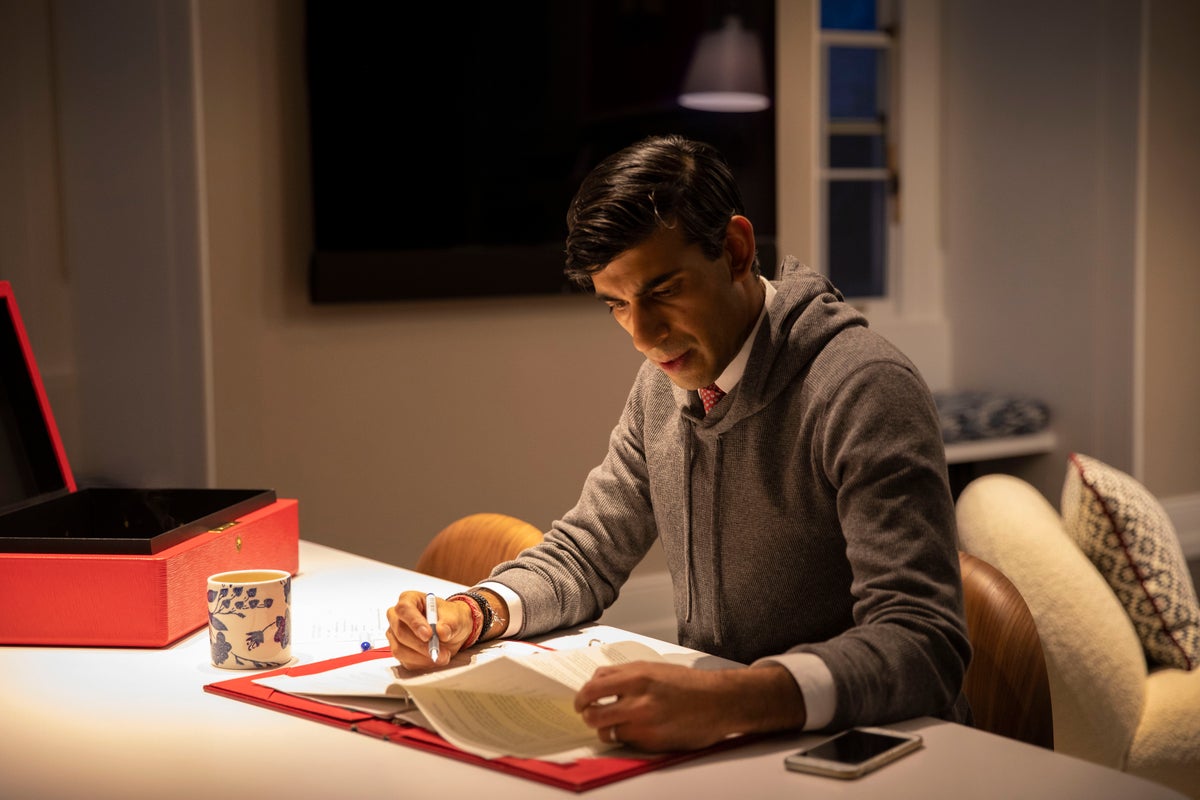
Maybe people will look back at teenagers in DCs and hoodies, and wonder, “Why were the teenagers back then dressed so formally?”
That’s how I dressed when I was a teenager, twenty years ago. When people were afraid of youths wearing hoodies. Front page news: BEWARE THE HOODIE! And now there are photographs of politicians wearing hoodies to make themselves seem more normal. More like the average working class man. Rishi Sunak, the British MP, trying to fool us in his hip garb.
Could you imagine Winston Churchill wearing a hoodie?
We think the ideas we are having now about people being scared of vaccines, or getting angry at cancel culture, are modern problems. And they are, just as they have always been.
This is a classified ad from 1952 –
There are articles from the 1800s about the new smallpox vaccine. One article from the Chamber’s Journal, July 31, 1886, reads, “The newspapers constantly remind us that there are many persons in the kingdom who object to vaccination…”
qrf
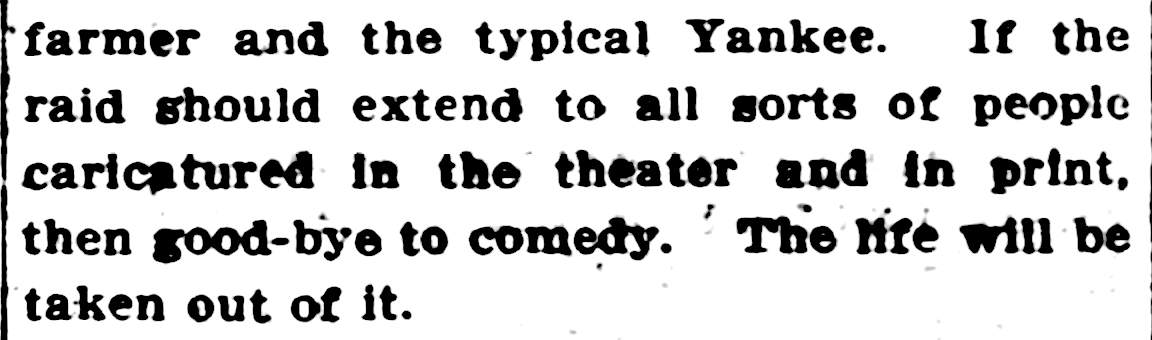
Comedian’s from 1903 declaring we can say, “good-bye to comedy” because racial and ethno stereotypes were banned on the stage.
In 1957, comedian George Gobel said, “…a TV comic nowadays needs the soul of a seismograph to know where the rumble of public wrath is coming from. We have to be verbal tightrope walkers.”
It has always been this way, and so it will remain. Nothing changes. Not really. We are not advanced. We have not learned from our ancestors.
We have always been, and will always be, modern.
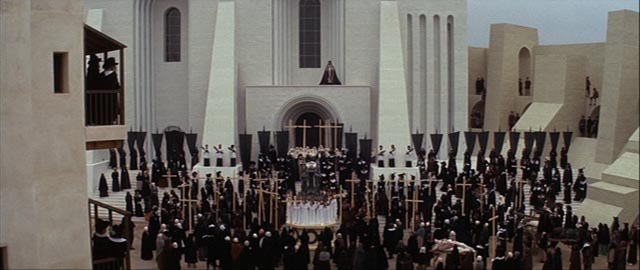
There is a film from 1971 by Ken Russell called The Devils. It was banned pretty much everywhere for its blasphemous sex scenes (the infamous raping of Christ being the main problem), and has still not been released in full by Warner Bros. But that film did something very interesting. If you watch it, it looks weird to the eye. The sets are all so… modern. The prison scenes have bright white tiles, brand new bars. The town walls and the castle are clean and built with new stone.
The film is set in 17th century France and when the set designer came to build the sets, he went, as one does when making a historical film, to create moulds of crumbling walls. Ken Russell stopped him, reminding him that at one time these old castles were not old castles, but modern architecture. And so they built them as new. When we watch The Devils, we are not watching old fashioned people in the past being barbaric, we are watching modern people in the present raging against new ideas, just as we do now.
People have always had complex thoughts. There has always been extremes in outlook. There have always been people who are racist and bigoted, but there has also been people who are against those things. Not everyone in the 1800s was racist, otherwise the politicians, who sink or swim in an ocean made of popularity, would never have been able to abolish slavery.
This post has gone on longer than I had planned, and it’s all to illustrate one point. One lesson about writing historical literature. We must view them with a modern eye.
The thing is, about those cowboys I write about in my westerns, they have no idea that they are living in the past.
Okay, so this is basically an escuse to react to a mad video that I think you will enjoy…
I made a video reacting to Marjorie Taylor Greene’s Republican campaign video.
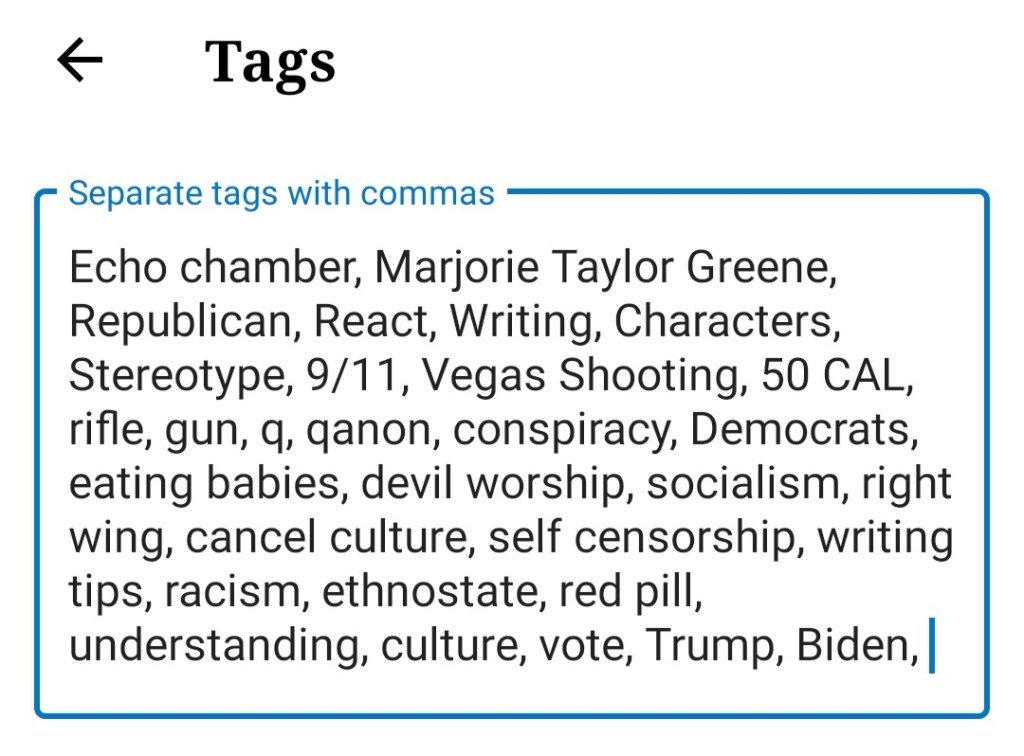
Here’s a picture of the tags I set for this post. I think they speak for themselves –
I talk about the need to break out of your own echo chamber in order to create believable non-stereotypical characters in your novels, but really I just wanted to share the madness of a the far right conspiracy believing politician.
“WIN THIS 50 CAL GUN!” if only politicians in the UK had incentives like that…
I have been stuck on Chapter 27 of Hell’s Ridge since the 16th November!
I’ve just looked back at my Instagram posts and saw that, on the 16th, I wrote, “Stupid chapter 27. I’ve been looking at your for nearly forty minutes now”. Well, that forty minutes turned into a month.
900 words in a month. It has never taken me that long. But, I finally broke through. I got it down and the floodgates have reopened. It was that 20,000 word hurdle.
I wrote a short story last week so I haven’t been unable to write, it was just that bloody chapter 27. When you come to read it, and you get to that chapter, you ‘ll wonder what all the fuss was about.
Now I’m back on track and ready to finally get this thing finished. Only 15k to go.
Sometimes writing is just hard. Every word is like hefting a lump of marble onto the page. For me, the rewrite is my enemy. What’s the hardest part of writing for you?
When you’re writing a novel sometimes you have to do a bit of research, and sometimes that research brings up incredibly interesting and surprising things.
In this video, my beard (which I’ve been growing for a year and a half) gets the scissors! And then I talk about a new “Mandela Effect” that I have discovered while researching ostriches. Can you describe an ostrich’s foot without Googling it? Answers below!
Where do writers get their ideas? I found a whole bunch of famous answers (“From an ideas shop in schenectady,” – Harlan Ellison) and some less famous but often funny answers from other authors.
The question, “Where do you get your ideas?” is asked of every author at some point in their career.
If you are looking for tips to improve your writing you will find them here. But you will also discover that doing whatever the hell you want can work just as well too.
Gertrude Stein, the famous American novelist, poet, and playwright said –
Punctuation is necessary only for the feeble minded.
Before we venture into the spiralling madness of authors who go against the rules, I just discovered that the word “playwright” is written P L A Y W R I G H T . I assumed it would be spelled P L A Y W R I T E . Like someone who writes plays. Playwrite. This might be because I am a fool. It might also be because the English language is endlessly surprising. Etymologically speaking Playwright is similar to wheelwright. A wheelwright was someone who wrought wheels out of wood and iron. And so a playwright is someone who has wrought words into a dramatic form. Like the words have been hammered and bent into submission.
But this isn’t about playwrights. This is about rules god damn it, so let’s get to it.
There are hundreds of books about the rules of writing correctly. As authors we walk a tightrope of good grammar. At any moment we could fall into a pit of dangling participles, passive sentences, repetition, the much feared adverb that reveals the writers inability to show instead of tell, repetition, a misplaced comma, and god forbid; a rogue semi colon. And worst of all, repetition.
But how important are these rules and how much are they going to actually hinder your success?
Rule one
Only ever use he said or she said, and never follow it up with an adverb.
You don’t even need to use he asked, or she replied. He said is a tag to notify the reader who has spoken. They become invisible to the reader. We scan over them as we read.
Of course you can say, said Graham, or Susan said, but be warned; only do that if you have characters named Graham or Susan. If not, I would recommend using the names of your own characters. The key here is economy of words, and clarity. The reader wants to know who is speaking but nothing more. All the dramatic work should be done in the dialogue or the surrounding prose.
You might have a character at the breakfast table. His wife has prepared breakfast for him. And we get the following piece of dialogue. “I wanted my eggs runny, not raw,” said Graham, angrily.
Instead of using the word angrily, you would write something like, “I wanted my eggs runny, not raw,” said Graham, picking up his plate and throwing it at Susan.
You see, we have a vivid image, instead of “angrily”. There is no doubt that replacing the adverb is better.
Unless of course, you are one of the bestselling authors of all time.
Stephen King said about J. K. Rowling –
Ms Rowling seems to have never met an adverb she didn’t like.
It’s true. Her prose is littered with them.
I’m a sucker for this rule and I try to never use adverbs. But maybe I shouldn’t be afraid of throwing a few in every now and then. It hasn’t exactly hindered the success of Harry Potter.
Exclamation marks!
Avoid them. If you have more than three exclamation marks in your entire novel you have too many. It is lazy. It doing work that should be self-evident in the words being spoken, or the events that are unfolding. If you need to add a nudge at the end of sentence to let the reader know that THIS BIT IS REALLY SURPRISING then something is wrong.
Your words should speak for themselves without the fanfare to highlight how loud someone is shouting or that an explosion is really big. And just on an aesthetic level it makes the page look cluttered and messy.
Having said that, in Joe Hill’s hugely successful book, NOS4A2, there is an exclamation mark every time Charlie Manx, the bad guy in the story, speaks.
You will also find an excessive use of exclamation marks in the books of Tom Wolfe, F Scott Fitzgerald, Jane Austin, and of course the biggest offender of all, James Joyce.
Some people think of those authors as being amongst the best literary writers in history. So maybe using more than three in a book won’t be so bad.
Speech Marks
Here’s a curious one; when writing dialogue should you use the double quotation mark or the single one? That has a straightforward answer.
The publishing standard in the UK is to use a single quotation mark. And in the US, they use the double quotation mark.
Unless of course you’re the bestselling author Roddy Doyle, who uses neither. He just starts each piece of dialogue with a dash.
Cormac McCarthy, author of No Country for Old Men, and The Road, didn’t believe in speech marks either, saying –
I believe in periods, in capitals, in the occasional comma, and that’s it.
On the subject of basic punctuation, in the last twenty-four thousand words of James Joyce’s Ulysses there are only two full stops and one comma.
So what’s the point of all this? Well, simply, there is no right or wrong way to write well. You can do whatever the hell you like. The books that break through and become huge bestsellers are littered with broken rules. Nobody in the publishing industry can predict what makes a book become a bestseller. Writers have tried to hone their craft with best practices but, ultimately it’s for nothing.
My advice is that you should learn and understand all these things and then use them at your discretion. Be free to write the way you want to write.
Maybe you don’t need to polish your prose into a smooth perfectly formed generic thriller. Let it be a bit rugged around the edges. Let a bit of your voice come through.
Writing is like music. You can release a highly produced pop song that does well in the charts, and you will do well. For me, those songs are polished so smooth I bounce right off.
Or you can be like Bob Dylan. Sometimes he would screw up a word while singing and just say the word again. He didn’t even go back and rerecord it. It’s right there in the song. He might screw up twenty seconds in and just start eh song again, and it’s right there in the album. It’s those cracks in the perfection that let us in. It’s true for all art, and it’s especially true for writing.
That’s all from me!
To get notifications for new videos from me click subscribe and ring that notification bell. New videos come out every Wednesday.
If you are an author and you have a mailing list why not pop a link to my channel in your next newsletter. And if you do please let me know and I will plug your book in a future episode.
TikTok is a social media app that mostly involves lip syncing teenagers and dance routines. It is not a place for literature… Seems like the perfect place to chisel out a niche.
If you are unfamiliar with the format, here are the basics:
There are three ways to post content; a 15 second video, a 60 second video, or a photo montage.
You can easily add special effects and filters. You are limited to 100 characters in your description, which must include your hashtags.
You film your short video, post it, and with any luck you start to amass likes and followers.
I am new to TikTok but I thought it might be interesting to share any insights and tips that I glean along the way.
Here is the first TikTok I made with my manifesto –
It is important as authors that we experiment with different ways of reaching and interacting with readers. This TikTok thing might crash and burn, but it might not. Either way I’ll be doing weekly updates with stats right here on my blog. So please follow me if you are curious about how this goes. Maybe you’ll decide to take to TikTok too, in which case you must let me know; we’ll do a duet.
I’ll get into TikTok duets in another post but, should I gain momentum, a duet is a way of giving new TikTokers an introduction to like minded followers. We’ll grow together.
The link below will take you straight to my TikTok profile. Feel free to cringe at my early attempts at content. Eesh. It’s a learning process, right? And don’t forget to press that follow button!
So, I’ve been on TikTok for three days so far. At the bottom of each TikTok update on this site I’ll publish my stats so you can see my growth and decide if it would be a worthwhile venture for yourself.
I’ll share my failed posts, my successful ones, everything; the good and the bad. Things are going to get experimental and weird. Until next time.
I this episode of the Two Authors One Journal podcast (aka 2A1J) Rachel says something interesting about Charles Dickens’ secret other success, Andrew plays the harmonica (badly), and they discuss the benefits of writing with the music on.
We find out what music Stephen King and Douglas Adams listened to while they wrote and what me and Rachel are listening to while we write our novellas.
On the novella front, meet the protagonist of Call Me Oedipus (the working title for Andrew’s novella), and Rachel reveals the title for her Murder Mystery.
Listeners Questions has a new jingle! But it might change next week… It might change every week.
Find us on Twitter @2A1Jpod for updates, and be the first to hear about new episodes by heading over to 2A1J.wordpress.com and signing up as a member.





 Andrew Chapman / Author and Screenwriter