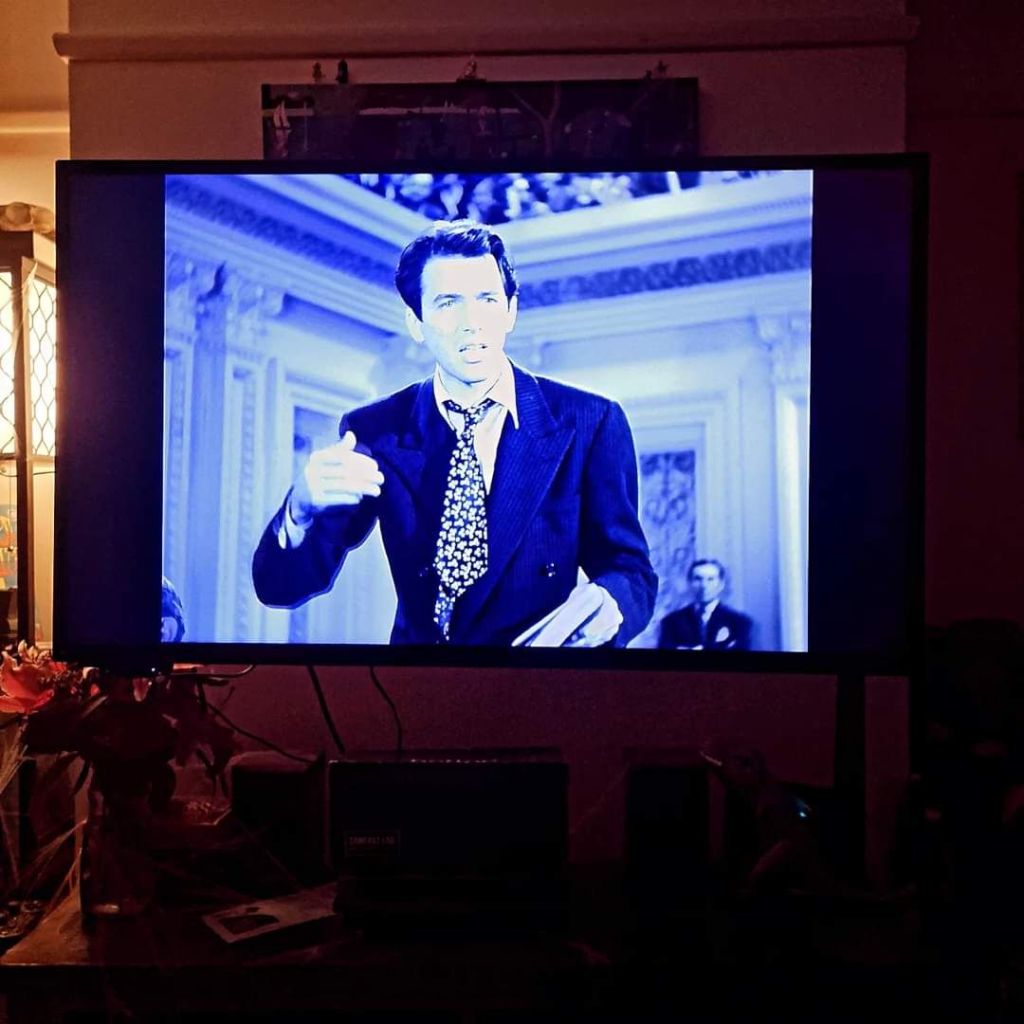
We’ve been on a Jimmy Stewart fix in this house recently, watching Rear Window, The Man Who Shot Liberty Valance, Winchester ’73, Destry Rides Again (one of his best in my opinion), tonight’s film: Mr Smith Goes to Washington, and soon, as with every Christmas, It’s A Wonderful Life.
He had a certain way with him, in his mannerisms, and the way he spoke, and his comedic intuitions. He was a funny actor. I would love to have written a film for him. I wonder if there’s a modern actor like him out there somewhere? I mean, I haven’t made a single film yet, but if you’re going to fantasise about a future career in filmmaking you might as well make it unbelievable. Anybody got a time machine I can borrow?
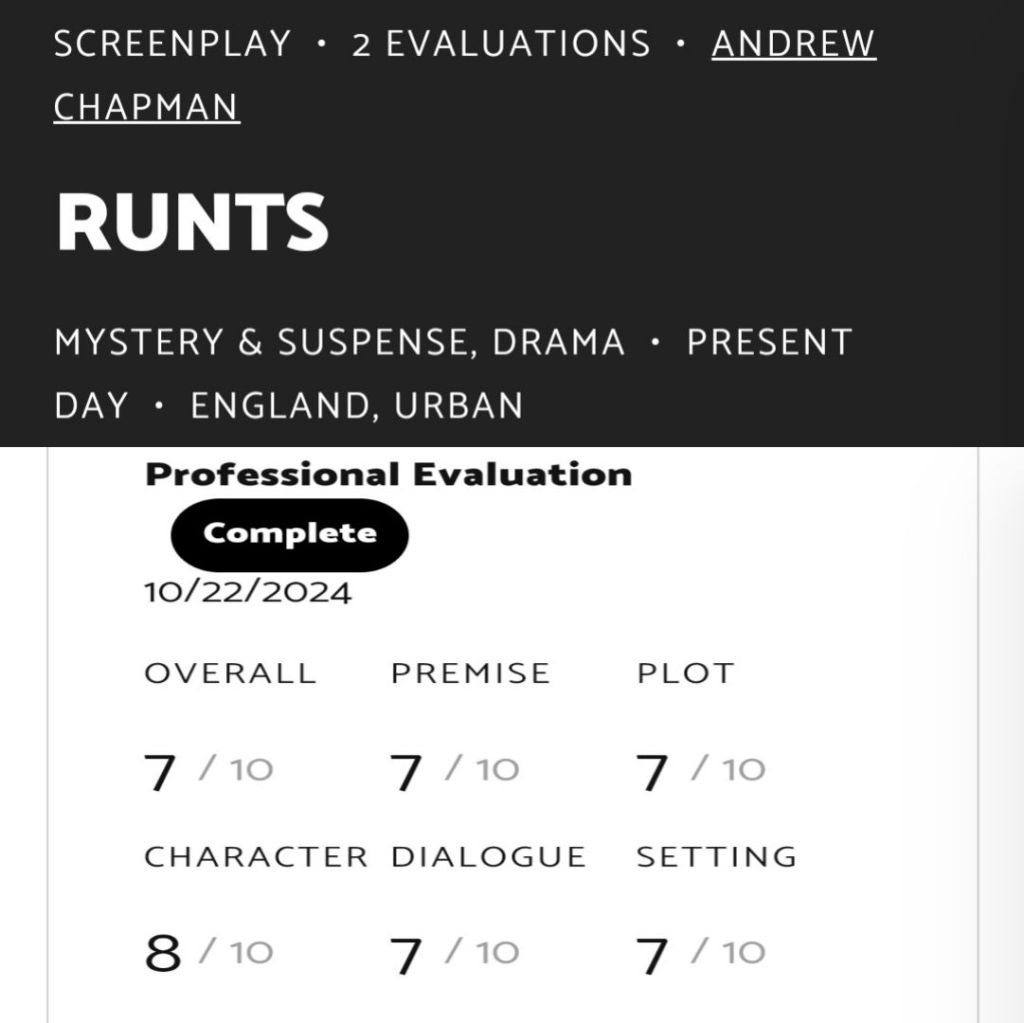
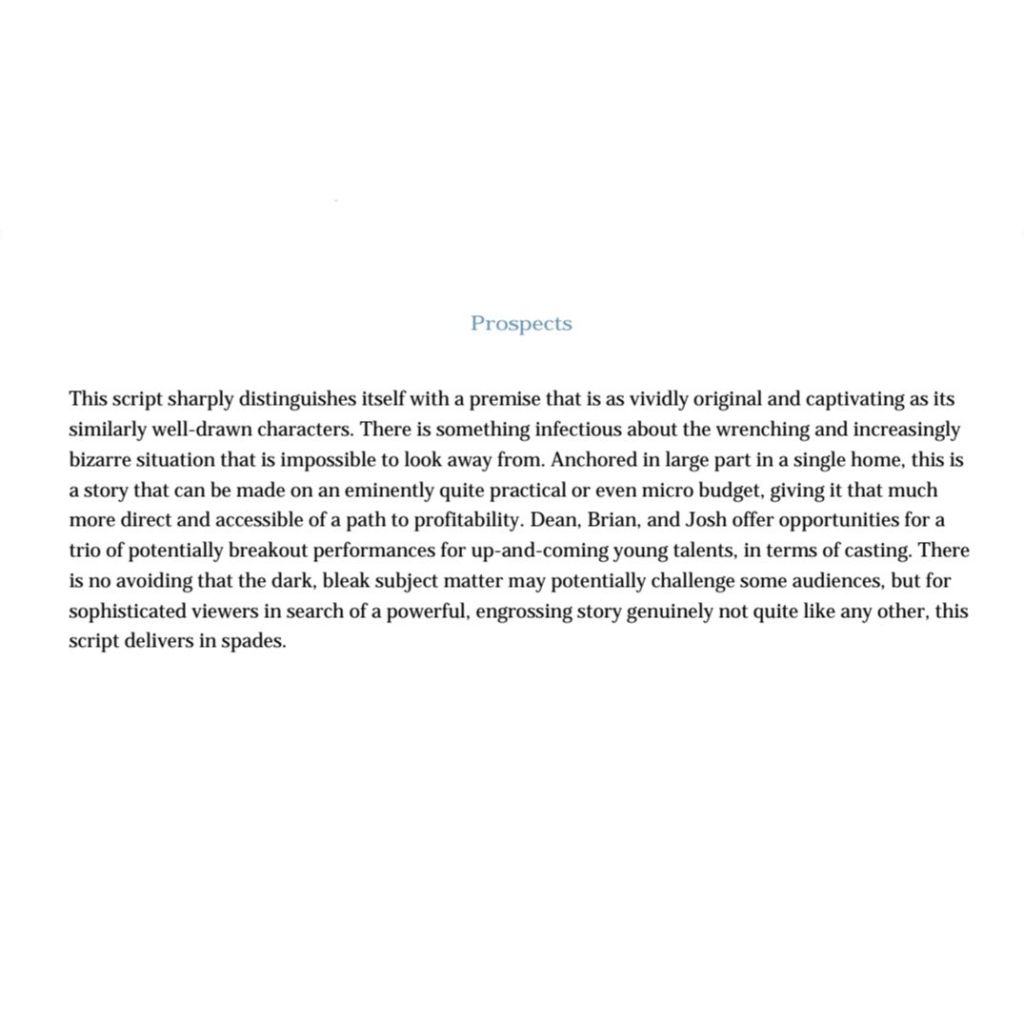
This has made my day! I just got a really excellent evaluation on The Black List for a screenplay I wrote called Runts. (I’ve shared the final part of the evaluation in the second image). A previous evaluation described the script as being “stunningly executed”.
The crazy thing is, I wasn’t sure about this one. I abandoned it a few years ago, convincing myself it wasn’t good enough. And then Rachel read it a few months ago and told me I was crazy, it’s great! (Her words). And convinced me to revisit the story and get it out there. Now I kinda love it.
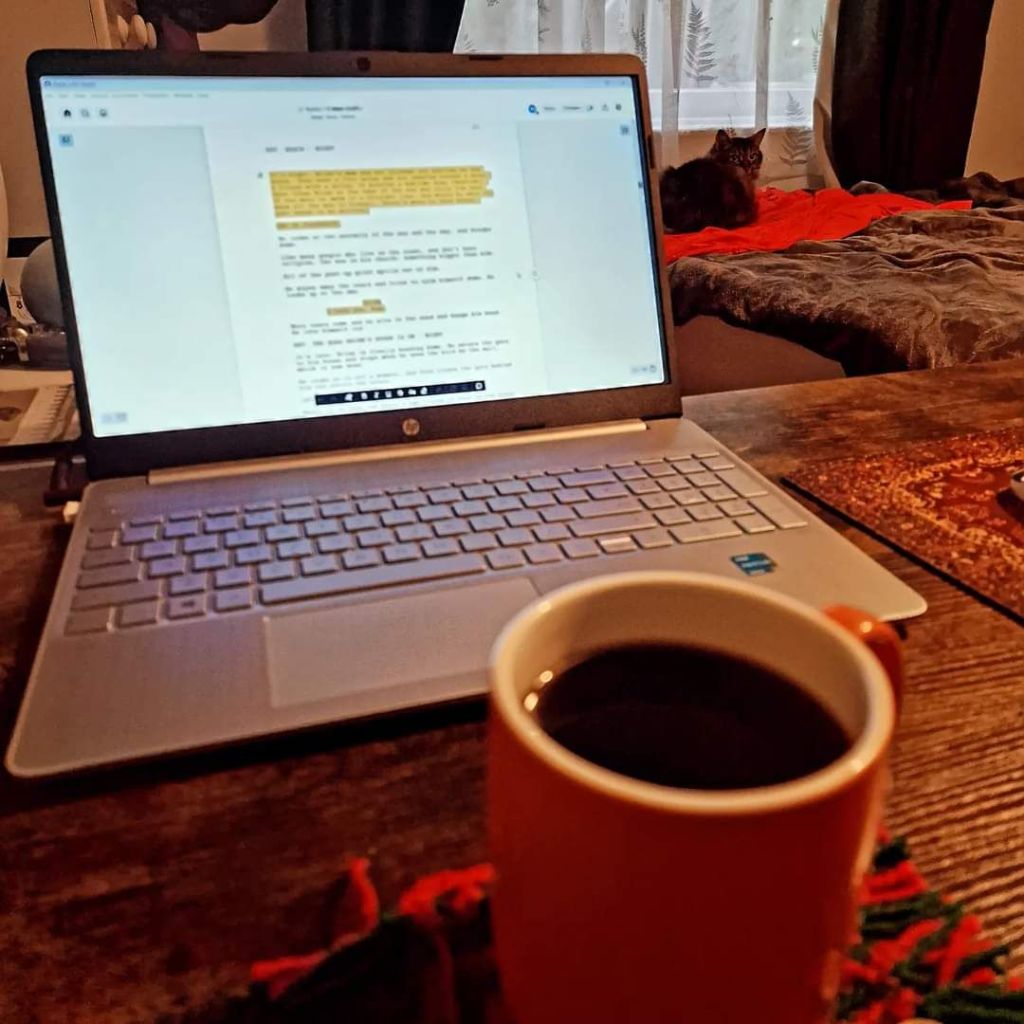
While I was between jobs, about a year and a half ago, I wrote a feature-length script in four weeks. This week, I read it for the first time since then. It’s a hell of a lot better than I remember. It needs a couple of new scenes and a slightly different ending, but I’ve got that all figured out, and I’m on a mission to finish it today.
The next step for this script is the almost impossible step. It requires luck, an incredible amount of random chance, and not much else. Somewhere out there is a director who is looking for something exactly like this, and our paths have to cross at just the right time.
RUNTS. A council house in the south of England. Night. Two young brothers bury their dead mother in the garden.
So begins a story of two boys, Brian, aged 11, and Dean, 16, as they learn to fend for themselves while keeping this dark secret. Things spiral out of control, and Brian begins to realise that there is something very, very, wrong with his older brother.
I was looking back over a book I had abandoned writing a few years ago, and was surprised by the final few paragraphs, which had nothing to do with the novel. They were instead my reflections on hearing the news about my dad’s diagnosis, which would take his life shortly after, and how death is the driving force that keeps me writing. If grief is a trigger for you, I would recommend skipping this post.
I wrote the following back in 2022, while Dad was still around, a few months before he passed.
***
There is no greater sedative than bad news. One month ago, my dad was told he had two months to live.
It was my mum who told me. Called me up, crying. They were leaving the hospital, on their way home. Didn’t want visitors. Needed to process it.
I called David in Spain. Told him. He’s on holiday with Arthur. Mum and Dad were meant to be there but stayed home to wait for the results of the MRI. Dad was told he couldn’t travel.
I’ve always felt that we are marching at full speed towards mortality. My dad took a wrong turn and slipped off a cliff.
I was in the middle of doing the dishes when Mum called and after the phone call I got back to it. Rachel followed me into the kitchen and said I didn’t need to worry about some dirty pots. But I did, because they still needed to be done.
I think I washed one cup before I had to stop. I leant against the counter and stared at the floor. We talked, though I don’t remember what either of us said, and then a spontaneous burst of grief caused me to push away from the counter and sob into that gap between Rachel’s shoulder and neck.
I read somewhere that writers avoid death. I think that’s why I do it.
I write so that when I am gone, my daughter can pick up one of my books and say, ‘There you are, Dad.’
It’s got me thinking about voice. Anything other than death. Voice as in the authorial voice. A lot of creative writing advice focuses on removing yourself from the prose. The author should never be present. I disagree. Whatever style I have is fundamentally me and too much tidying up of the language will remove me from it. I don’t write to deliver a plot. I write to save some part of my soul. That’s not as grand a statement as it sounds. It’s vanity, really. And terror.
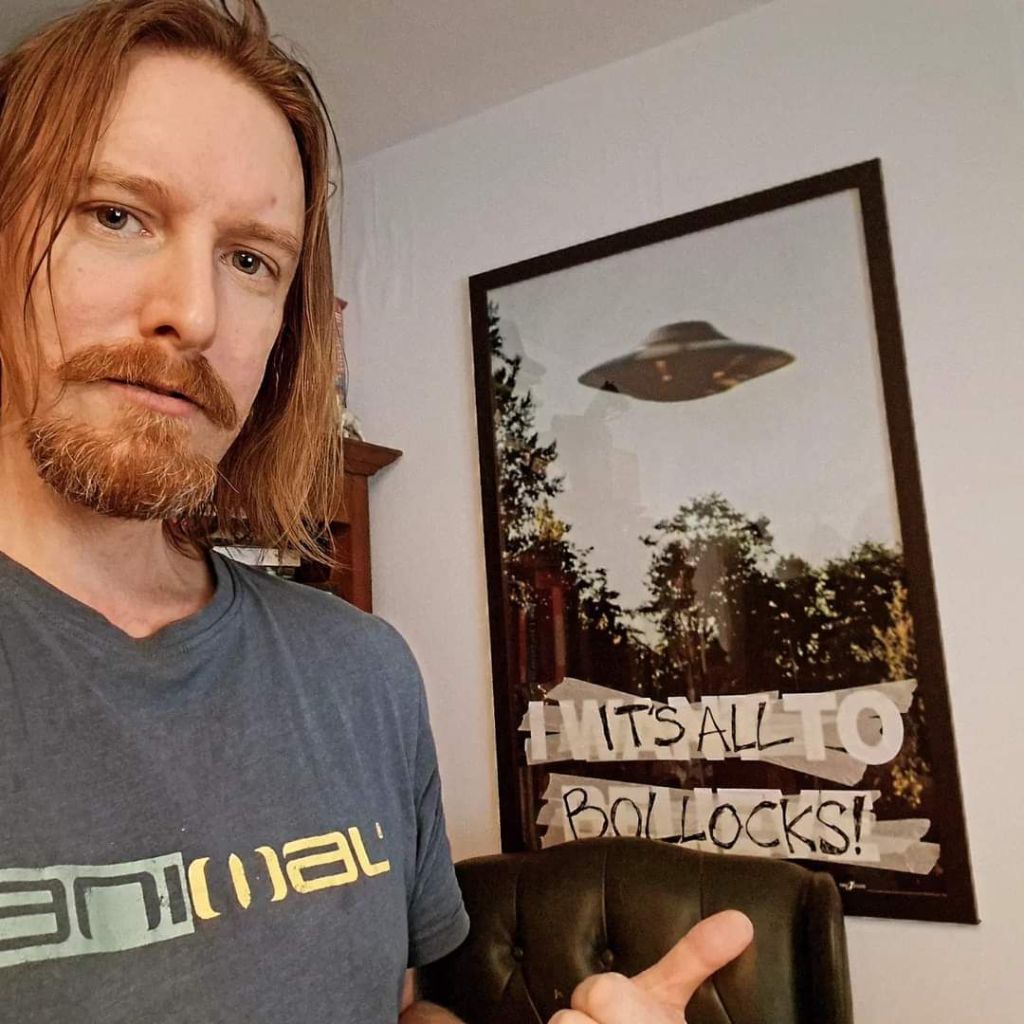
I’m currently writing a pilot episode for a tv show (an original idea that nobody knows about yet), and I needed to get more inside the head of the main character than I was. He is Fletcher Madoc, an internationally renowned sceptic and debunker of conspiracy theories and myths.
On the wall of Fletcher’s office is the iconic poster from Fox Mulder’s office in the X-Files, but he has covered the words I WANT TO BELIEVE with the words IT’S ALL BOLLOCKS.
Trying to make fictional people feel real is an important and tricky thing to get right. I highly recommend bringing their reality into your own.
Many of you will already know that on my birthday this year, the 12th May 2022, I attempted to write an entire novel in a single day. I succeeded. The novel is called The Mask Collector. At 7:30am on the 13th May, tired and weird, I wrote the Author’s Note that will appear at the beginning of that novel. I would like to share it with you here.
The Mask Collector
Author’s Note
This novel is the product of a single frantic day at the keyboard. I sat down at my desk at 9am on the 12th of May 2022 and I was still there at 9am on the 13th May (I’m actually writing this with an hour and a half still to go, but I know now that I will make it to 9am and my brain needs a break from the fictional).
I had a goal that I didn’t achieve. I thought I could write fifty thousand words in a single sitting (an idea born from The Bestseller Experiment podcast.) I was wrong. I managed half of that.
I mean, I didn’t really think I would be able to do it. I just wanted to try. 50,000 words. It’s an absurd number. It’s short for a novel, which average around seventy thousand, but the average novel takes a year to write. I was trying to do it in a day.
I both failed and succeeded. I told the whole story. It was complete when I finished. It was just much shorter than I had hoped. I ran out of road.
If I were to attempt it again (very unlikely—though it wasn’t an unpleasant experience), I would probably not adapt a screenplay. I thought doing that was a clever trick to save on having to think about what happens next.
I wrote the screenplay of The Mask Collector during the first Covid lockdown. A complete feature-length film. And a good one too. In the words of Mark Stay, it had blockbuster potential.
When the idea came to me to attempt this feat, adapting it seemed like the obvious thing to do. A screenplay is basically a very detailed outline. The problem is, it’s too detailed. I was caged in. I couldn’t let go and fly. It was a machine job of mechanically re-describing scenes that already existed with little scope for improvement, as it had already been worked and reworked in its original format.
If I had come up with a completely new idea and given myself a far looser outline, I might have been able to get in the zone and lose myself in rapid fire prose.
But I’ll be honest. The goal of reaching a big word count is a shallow one. Story is king. That’s the most important thing. Authors often forget that. We get carried away with what is expected and don’t let the story tell itself at its own pace. I didn’t succeed in writing a novel, but I did succeed in writing a novella. A lot of my favourite books are novellas (The Great Gatsby, Animal Farm, The Metamorphosis, The Heart of Darkness, The Strange Case of Dr Jekyll and Mr Hyde, The Body, Rita Hayworth and Shawshank Redemption, The Langoliers, The Mist, The Rats, The Hellbound Heart, War of the Worlds—should I go on?) and I’ve been writing a lot of them recently.
Under the penname, Elwood Flynn, I’ve been intentionally writing thirty-five-thousand-word pulp westerns. I love reading them and I love writing them. I like the leanness of the prose. The challenge of pairing the language back to its most raw form. It’s no wonder this ended short.
One of the great things that came from this was that I got to rediscover The Mask Collector as a reader. I had forgotten a lot of the script. I hadn’t realised how much of it I had forgotten until I started this experiment. It surprised me. What surprised me more was how entertained by it I was. I felt the suspense of the intended viewer/reader as I adapted it. I fell in love with the characters all over again.
A lot of the people reading this were there with me the day I wrote this. So many fellow authors and readers rallied around me and tweeted all day and night cheering me on and offering support (you got it to number ten in the horror charts between Stephen King and Stephen King, and it hadn’t even been written yet). It was a great day. An excellent way to spend a birthday. I was doing what I loved with the people that I love. The teenager was at her mother’s studying for her GCSEs, which start next week, but Rachel and the cat were here, cracking the whip (and making me coffee).
When things got desperate, at about 3am when the story was done and I didn’t know what to do to make the book fatter, I had a radical idea. The main character in the book is Pat Caine. He is a famous retired bank robber who wrote a very successful book about his life of crime. That was it! I could write chapters from his book, from his point of view, and place them randomly throughout the book! Problem solved.
I wrote two chapters. Told two stories from his early life. In one, Caine is fourteen and getting up to some thieving hijinks involving a milk float. In the other, he is twenty-four and planning his first bank robbery.
When it came to placing them in the story, all it did was slow down the pace. They were jarring. I have included them at the end of the main story for your amusement. They were written by an exhausted mind at an ungodly hour.
So, without further ado, I present to you, The Mask Collector. It was written with passion and sleep deprivation. I think it shows. I hope you enjoy it. Be kind with your reviews.
I think you will like DCI Conrad. I’m sorry there’s not more of her. Another book maybe. Another time.
Andrew Chapman – 7:45am, 13th May 2022, Bournemouth
I was listening to the Tim Sullivan episode of the Bestseller Experiment podcast (really good episode, very inspiring) and it got me thinking. The idea of writing a whole novel in a day came up… and I’ve decided to give it a bash.
It has been done before. When I published my first book back in 2011, there was another indie author skulking around the forums who did it. Nick Spalding wrote Life… With No Breaks in a single sitting. It was impressive and it did very well, launching an incredibly successful career.
I’ve been doing a bit of research and it’s proving difficult to find other examples. The Boy in the Striped Pyjamas by John Boyne was written in two and a half days. That’s the shortest time period I’ve been able to find (in an admittedly brief Google search).
I’m going to aim for 50k. That means I’ll have to write just over 2k every hour for 24 hours. No sleep. Short breaks for food. A lot of coffee. And a pillow for my arse which will no doubt be aching by the 12th hour.
I have an advantage. In order to do it I’m going to be adapting a screenplay that I’ve already written: The Mask Collector.
There is a very good reason for not starting a story from scratch. The thing that slows me down most is trying to work out what happens next. All that thinking has already been done. If I were to start from scratch and force my way through a first draft of something new I would end up with a very bad incoherent first draft that would need a complete rewrite and so be pointless.
Prosatizing a screenplay (that’s a new word I just invented. I could have used “adapting” but prosatize is way more sexy) still requires creative juices and enough mental capacity to write something worth reading and not just a stale transferring of words with the tenses changed. Novels are a very different beast to a no-nonsense script so it will be a serious challenge.
I don’t know if I’ll succeed but I’ll be bashing out words to the final second of that 24th hour and hopefully I will start my 38th year on this planet with a new novel under my belt.
12th May 2022 (my birthday). 9am to 9am the following day (which is Friday the 13th 😳). The Mask Collector will be reborn as a novel.
I’ll be sharing my progress on Twitter and Instagram. I am @AndyChapWriter on both.
5am is a good time to write. Blue Pulp is getting exciting. The western is an underestimated genre. When you strip everything out, all the things that distract us in the modern world, so all you have is the man and his thoughts, you can get deep and frightening with the human condition.
I know you can’t buy any of these books yet but soon you’ll be able to. This is book three and I’ve got one more to write. I think I’ll be done by spring.
I was reading a western last night. A slim novella. Less that 200 pages. There is something engaging and lively in the telling of a shorter novel. Something I embrace in my own writing.
I can wait for you to read this. If you’ve never read a western before maybe it’s time to try it out.
I’ll be posting covers and release dates right here over the next few months.
I have been staring at chapter ten of Blue Pulp for an hour. I wrote thirty six words and then stared at them for a while. They were no good. There is something I’m missing. Something my subconscious is aware of but I am not. There is another, better way, for this chapter to be than the one I have in mind. I need to sleep on it.
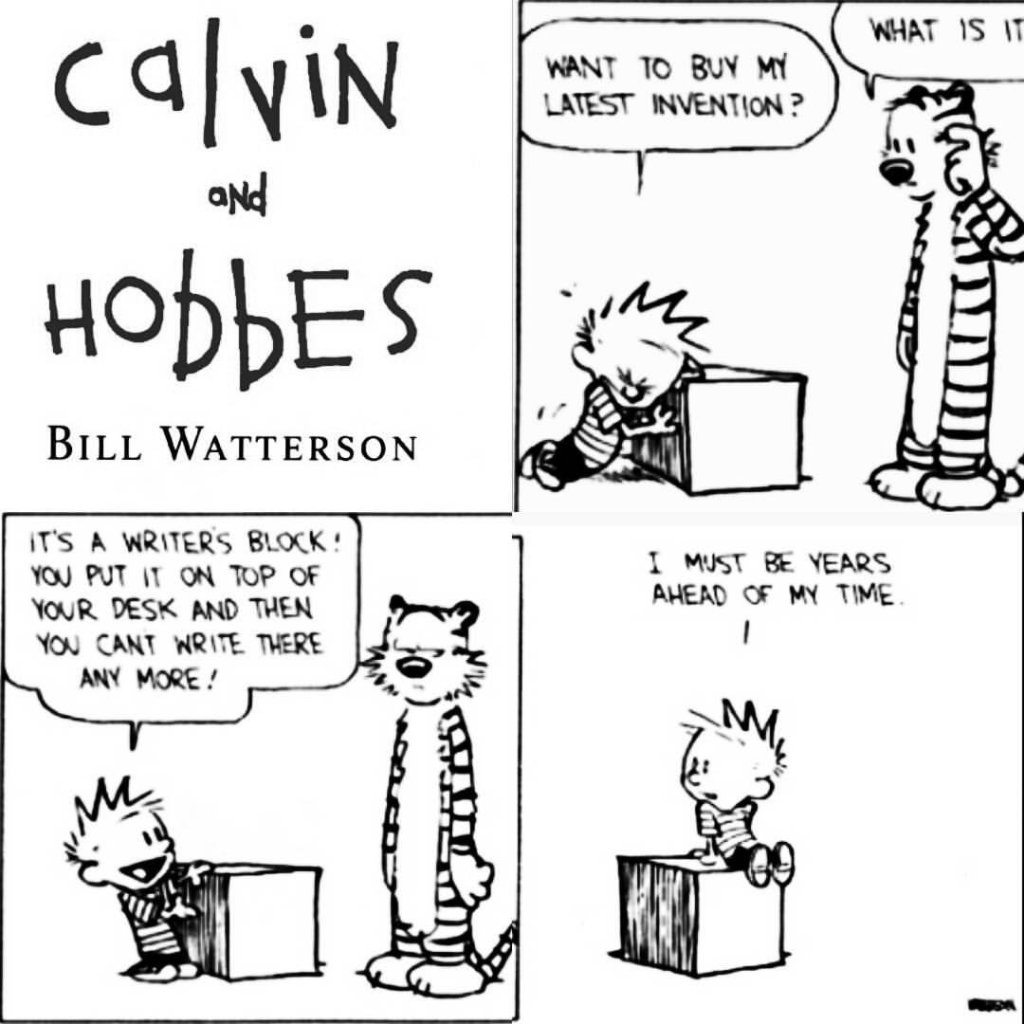
This is what some people call writer’s block. It’s not a block of words, I’m still capable of laying down the letters; it’s more like the engine that powers the imagination is running on fumes and requires more fuel. Fuel is often made of caffeine, this time it requires something more ethereal. It needs inspiration. A new idea.
Normally in this situation I tell the story to Rachel and it turns out I knew what needed to happen next all along, my subconscious simply needed me to verbalise it. This is different. The path ahead is blocked. A new path must be made before I can walk it.
I think the problem lies in a simple storytelling problem. So far the whole story (a western) has been told from Robin Castle’s point of view (from the third person, but we as the reader only know what he knows), and I need the reader to see what another character is doing as Castle walks away from town with trouble coming up behind him.
I need to break the unspoken rule I have set for the novel. I need to look away from Castle. Maybe that’s the problem.
You see, we’re solving it together right here. So what do I do next? I’m going to ask my subconscious to figure this out and let me know the plan in the morning. I’m going to bed.



 Andrew Chapman / Author and Screenwriter