One Page Punch Up

I submitted the first page of my new book to The Bestseller Experiment podcast to be criticised in what they call a One Page Punch Up. There were many submissions but, to my joy (and sudden apprehension), I got selected!

And so best-selling author, Mark Stay (author of Back to Reality and the film Robot Overlords starring Gillian Anderson and Ben Kingsley) and Juliet Ewers (Publishing Associate at Orion Publishing who has previously worked with Ian Rankin and Michael Conolly) critiqued the opening page of Shelley Town RPG, my latest novel (it’s a Stephen King-esque horror).

The episode came out. Me and Rachel pressed play and listened. A grin started to spread across my face. By the time it was done we were speechless.

If you want yo hear what these two respected experts had to say about my writing you can listen on the link below! They reviewed five pages. Mine is first so you won’t have to scroll through the audio trying to find me.

EP231: One Page Punch-Ups with Juliet Ewers

Swearing in Literature

swear book

In Better Angels of Our Nature, Stephen Pinker says that swearing is a sign of a civilized society. You’re not going to be hung for comparing a member of the royal family to the back end of a donkey. We have progressed beyond that. There is no doubt that there is an offensive side to the English language but you are free to use it as you please. The question is; when should it be used, and when should it be avoided?

If you are writing a picture book for three year-olds it’s probably best that the talking squirrel doesn’t have speech bubbles filled with expletives. But that’s obvious to anyone so let’s focus on fiction aimed at adults. The reason this subject is on my mind is that I’m reaching the end of writing a horror/thriller novel and as the first rewrite looms I start to think about these things.

There is swearing in my book. It is occasional and mostly in the dialogue. I only paused for thought when I came to edit the moments where the fourteen year-old children in the book swear. To justify this I’m going to drag out two very important words; realism and context.

Fourteen year-olds swear. You might not hear them doing it, and not all of them do, but most, when amongst their peers, use “bad” language all of the time (in fact I’ve questioned my twelve year-old daughter on this and she has confirmed that many of her friends do indeed have potty mouths. She of course is an angel, or so she tells me). You can avoid it in your writing but sometimes avoiding it takes away from the realism of what you are writing. As I’m currently writing horror I’ll use horror as an example. Let’s say we have a fourteen year-old boy named Billy, and Billy has just witnessed the violent death of a parent. Is he more likely to mutter the word, “Gosh.” under his breath, or something more visceral? The word gosh would immediately destroy the believability of the scene. However, if you are writing a scene where Billy is enjoying a particularly good ice cream it would be unnecessary for him to comment on how f***ing delicious it was.

Here’s my dilemma, and the one that got me onto thinking about this in the first place; when is it okay to swear in prose, outside of dialogue? My thoughts on this are straight forward (but I have gone against my own advice a few times as I’ve looked at each individual case). If you take the swear word out no one is going to notice that it isn’t there, and so all should be eliminated. Whether or not swearing is okay in a civilised society there is no doubt that some people find it abhorrent. So take it out. People will happily read the murder scenes in your book and not flinch but as soon as they come across an F-word in the middle of a descriptive passage a big bell will ring in their head. Even if that ringing stops pretty quickly it is still jarring enough to drag you out of the scene.

So why have I left a few in? Sometimes your descriptive prose will reflect the thoughts of whichever character is in that scene, and that’s okay. It helps to clarify the mood your character is in. So you have a scene that goes – Terry stood on the side of the road looking at his smashed up car. The other driver, some drunk moron, was still sat in his driver’s seat, bleeding from the ears. Terry had two options, call a taxi and make it to the wedding on time, or help this stupid fucking drunk.

Alright, so that’s not a great example, but hopefully it illustrates my point well enough. Sometimes your prose reflects the thoughts, or the mood, of the main character in the scene.

swear keyboard

It’s interesting to me that there are no age guidelines with books, as there are with film and television. It is up to the responsibility of the author. But we’re not talking about sex and violence, we’re talking about language. You might lose some readers because they think your use of language is vulgar, but remember, that just makes you more civilised than them. Don’t swear for the sake of it though, the novelty wears off pretty quickly for the reader. So long as your portrayal of life is true then you won’t need to think too hard about whether or not that particular word is necessary.

Mellifluous Ramblings

Dictionary 4

The problem with reading dictionaries is that you find yourself writing words into your prose that you are certain you would not understand yourself if you came across it in someone else’s book.

But that’s how vocabulary grows so you should never shy away from it. The context should carry the word anyway. And if you read in the way I do, and come across a word you don’t know, google is at your fingertips with all the meanings and definitions for all the words and things in every language in all the world. Smart phones are magic impossible devices sent to us by aliens.

(I just want to say quickly that I am aware that using the words “but” and “and” at the beginning of a sentence is technically wrong. It is a matter of grammar that I dispute. If it is used widely in common speech it is acceptable in prose. I might expand in this point at a later date).

Anyway, I was talking about words you wouldn’t normally use. I wrote the following sentence –

She made a wonderful mellifluous sound.

In the interest of context, the girl mentioned in the above sentence was enjoying the intimate company of the protagonist (Ghastly isn’t it? Sex has no place in comedy, the scene will probably be deleted). Mellifluous is a word no one knows naturally. In fact it’s a word I didn’t know I knew until I wrote it and had to look it up to see what it meant and if it fit the sentence, which by chance it did. Osmosis in action. Mellifluous. I’m not going to tell you what it means (you may already know). If you don’t, think about what you think it means and then google it.

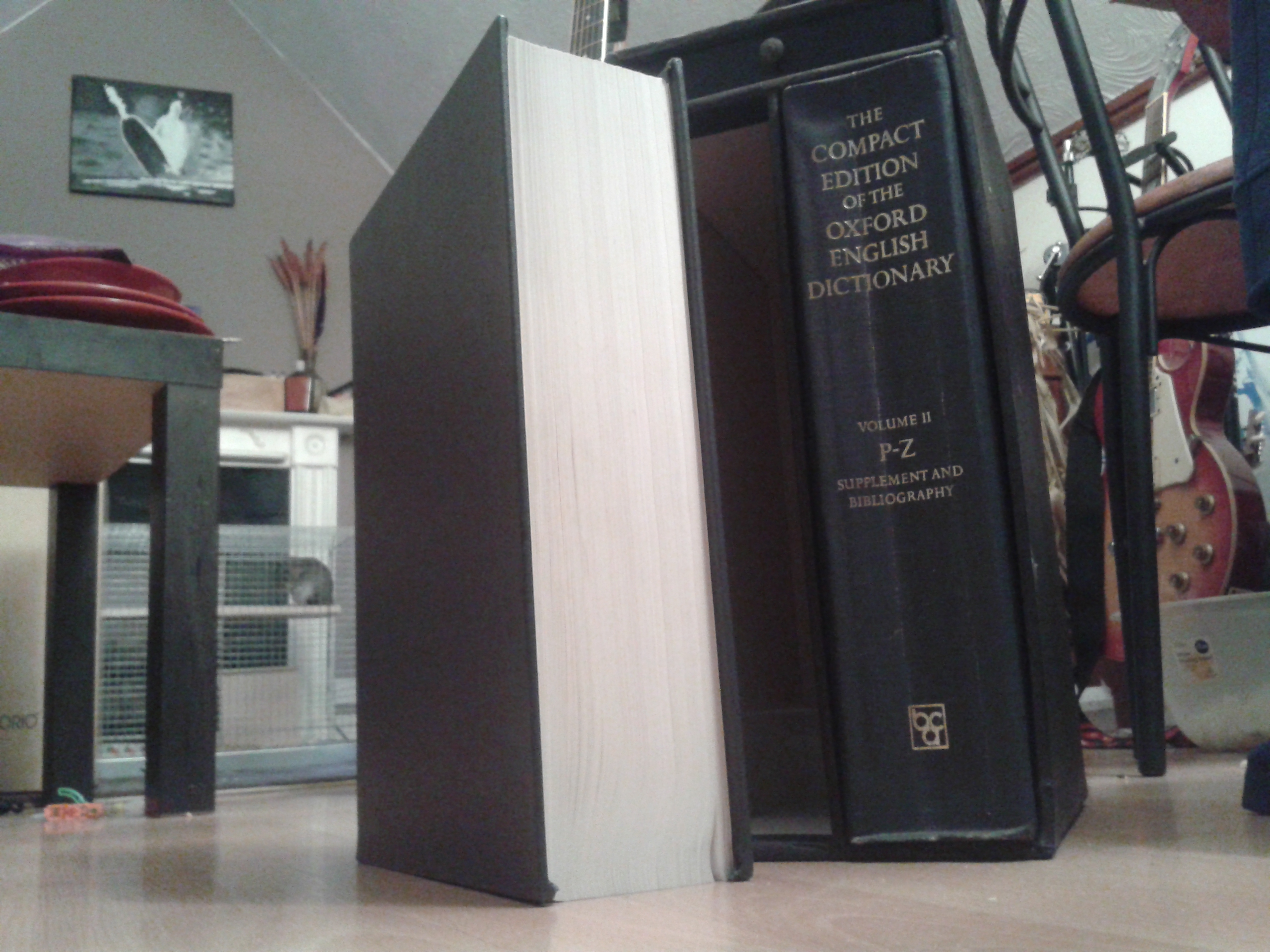
On this occasion I actually decided not to use the endlessly helpful Google (or the brilliant and underrated Wikipedia) and instead I took the opportunity to flop open my massive and beguiling Compact Edition of the Oxford English Dictionary. It has all of the words in it. Look at it. It’s enormous –

Dictionary 1

You see, it’s big isn’t it. Let’s open it at random and see what new word we discover.

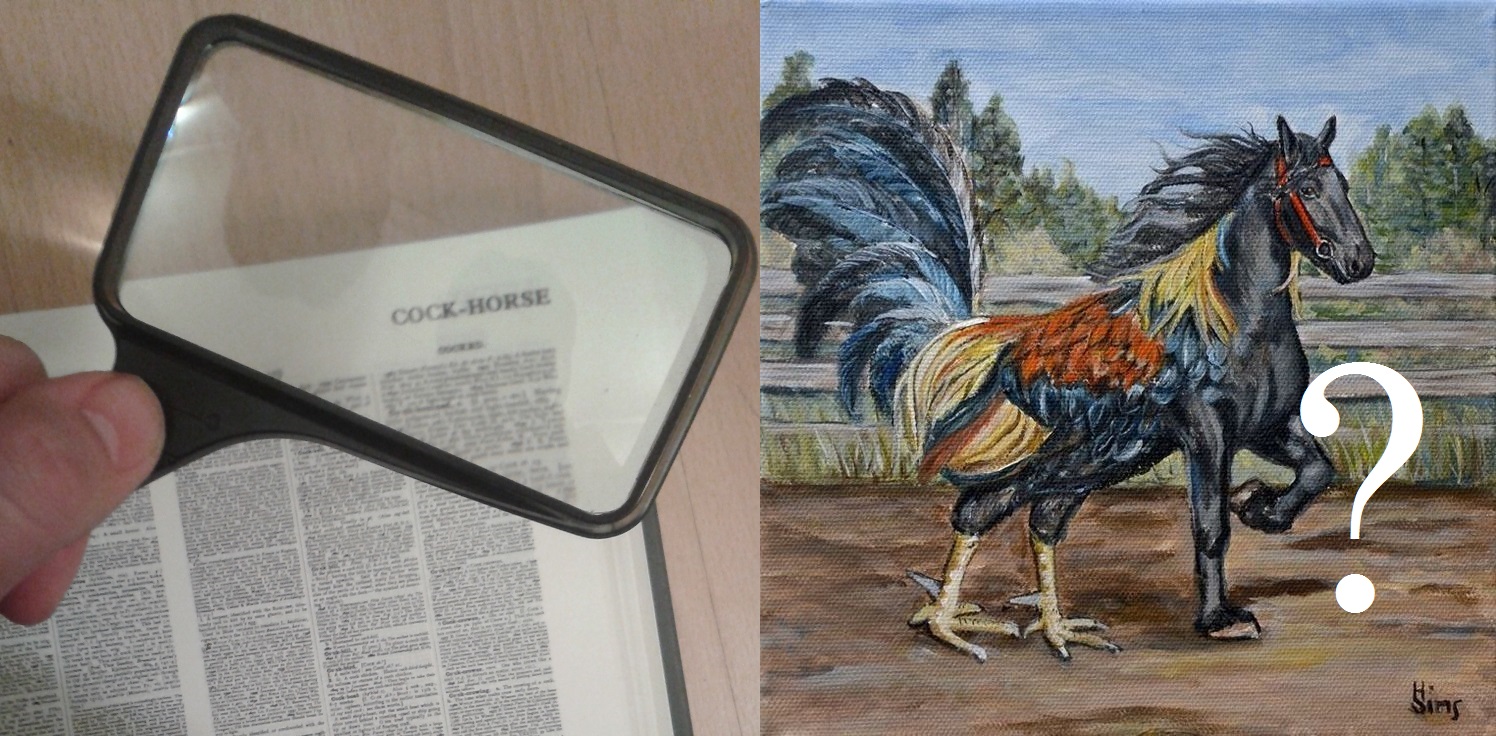
Dictionary 2

Cock-horse. Well, there we are. Who was expecting that? Definition –

(In the dictionary the definition is long and exhaustive so I’ll break it down) A Cock-horse is when a child rides an adults knee. Like a game. Pretending she’s riding a horse.

The massive dictionary makes for a nice light bedtime read for the kids too –

Dictionary 1

I mean, who has ever used the word mellifluous before? I know I haven’t. Well, I have now, 4 times. But you know what I mean. I don’t think I’ll be using cock-horse any time soon.

I seem to recall having some kind of point when I started this post. Until I got distracted by the dictionary. I might start doing a word of the month (or whenever I come across an interesting one). Here’s a good word – Hippopotomonstrosesquipedaliophobia. It’s the name given to the fear of long words. There’s a psychologist somewhere with a sense of humour. Some people add an extra “p” in the “…quippedalio…” bit. But that’s just silly.

Do feel free to share any interesting words in the comments.

If you liked this post you might also like this one – https://andychapwriter.wordpress.com/2014/01/14/paradise-lost-hobby-gained/

I Left my Words at the Airport!

Lost WordsI wrote a couple of paragraphs for my next book on my work laptop yesterday morning. I was on a small propeller plane on my way to Manchester. It was early and the flight was short. I took out the laptop and got typing. I liked the words that fell from my fingers. They were interesting observations about the waitresses in Las Vegas casinos. I think they were interesting anyway. I can’t remember exactly what I wrote.

I was there for a meeting but after it was done I had about 4 hours to kill before my flight home at 10pm. So I got a train from the airport to Oxford Road to meet a friend. We went to a pub. Had a pizza. Went to another pub. We drank lager and all kinds of different ales. Then it was time for me to go.

I was swaying a bit at the security check in at Terminal 3. I was the only person there. I had drunk some water and eaten about 15 Smints so I was more sober than I could have been, but not sober enough to pay attention to what I was doing.

In my bag was about 15 ink cartridges that had been taped together. They looked suspiciously like a bomb that had been disguised to look like printer cartridges. I was made to separate them and put them into small clear bags. My laptop was put in a separate tray.

I went through the scanner. It didn’t beep (a first in the history of Andy).

“I think you’ve missed your plane mate,” said the security guard on the other side.

“I don’t think so.”

“Let’s see your boarding pass.”

I gave it to him.

“That plane is about to take off, It’s due to leave at 9:25.”

I checked my watch. It was 9:22. “Shit, I thought it left at 10. Or there about.”

“You better run mate if you want a chance to get on it.” He pointed at the screen at the end of the room that listed the flights. “It’s at gate 144.”

I grabbed my jacket, put on my belt and slung my bag over my shoulder. I ran for the gate and arrived panting.

“Have I missed it?” I said, chucking my passport at the guy and slumping over his desk.

He looked at me like I was some kind of delusional mad man. “No. We’re not boarding yet.” He tentatively picked up my passport and handed it back to me. “Why don’t you take a seat.”

I turned around and there were people sat in the waiting area, staring at me.

“That fucker was messing with me.” I said, mostly to myself.

I sat down and looked at my ticket. The boarding time is 9:45. This is how these sick fuckers get their kicks. Watching people run at full speed away from the security check in fear of being stranded.

It wasn’t until I landed in Bournemouth that I noticed my bag felt a bit light. I had left my laptop and ink cartridges in Manchester. Fuck. My boss will not be happy. How will I do my job?

I called the airport security in Terminal 3. They seemed to be expecting my call.

“Hi, I’ve just landed in Bournemouth and I –“

“Forgot your laptop?”

“Yeah.”

“We’ve got it. You’ll have to call lost and found tomorrow afternoon. They’ll arrange to have it sent to you.”

I got in a taxi and met my sister for a beer. I’m not really concerned that I can’t get much work done without it, I can work around that, but those few paragraphs about the casino girls in Las Vegas. I need to get them back.

The first thing I did when I got up this morning was back up all my writing (I have two laptops, one that stays in the house and is used just for writing, and the work laptop which is used begrudgingly to do the things that result in money being in my account at the end of each month).

Losing words is far worse than losing a laptop.