Where Do Authors Get Their Ideas?
Where do writers get their ideas? I found a whole bunch of famous answers (“From an ideas shop in schenectady,” – Harlan Ellison) and some less famous but often funny answers from other authors.
The question, “Where do you get your ideas?” is asked of every author at some point in their career.
Where do you get your ideas?
Great Writing Advice Great Writers Ignore
Transcript
If you are looking for tips to improve your writing you will find them here. But you will also discover that doing whatever the hell you want can work just as well too.
Gertrude Stein, the famous American novelist, poet, and playwright said –
Punctuation is necessary only for the feeble minded.
Before we venture into the spiralling madness of authors who go against the rules, I just discovered that the word “playwright” is written P L A Y W R I G H T . I assumed it would be spelled P L A Y W R I T E . Like someone who writes plays. Playwrite. This might be because I am a fool. It might also be because the English language is endlessly surprising. Etymologically speaking Playwright is similar to wheelwright. A wheelwright was someone who wrought wheels out of wood and iron. And so a playwright is someone who has wrought words into a dramatic form. Like the words have been hammered and bent into submission.
But this isn’t about playwrights. This is about rules god damn it, so let’s get to it.
There are hundreds of books about the rules of writing correctly. As authors we walk a tightrope of good grammar. At any moment we could fall into a pit of dangling participles, passive sentences, repetition, the much feared adverb that reveals the writers inability to show instead of tell, repetition, a misplaced comma, and god forbid; a rogue semi colon. And worst of all, repetition.
But how important are these rules and how much are they going to actually hinder your success?
Rule one
Only ever use he said or she said, and never follow it up with an adverb.
You don’t even need to use he asked, or she replied. He said is a tag to notify the reader who has spoken. They become invisible to the reader. We scan over them as we read.
Of course you can say, said Graham, or Susan said, but be warned; only do that if you have characters named Graham or Susan. If not, I would recommend using the names of your own characters. The key here is economy of words, and clarity. The reader wants to know who is speaking but nothing more. All the dramatic work should be done in the dialogue or the surrounding prose.
You might have a character at the breakfast table. His wife has prepared breakfast for him. And we get the following piece of dialogue. “I wanted my eggs runny, not raw,” said Graham, angrily.
Instead of using the word angrily, you would write something like, “I wanted my eggs runny, not raw,” said Graham, picking up his plate and throwing it at Susan.
You see, we have a vivid image, instead of “angrily”. There is no doubt that replacing the adverb is better.
Unless of course, you are one of the bestselling authors of all time.
Stephen King said about J. K. Rowling –
Ms Rowling seems to have never met an adverb she didn’t like.
It’s true. Her prose is littered with them.
I’m a sucker for this rule and I try to never use adverbs. But maybe I shouldn’t be afraid of throwing a few in every now and then. It hasn’t exactly hindered the success of Harry Potter.
Exclamation marks!
Avoid them. If you have more than three exclamation marks in your entire novel you have too many. It is lazy. It doing work that should be self-evident in the words being spoken, or the events that are unfolding. If you need to add a nudge at the end of sentence to let the reader know that THIS BIT IS REALLY SURPRISING then something is wrong.
Your words should speak for themselves without the fanfare to highlight how loud someone is shouting or that an explosion is really big. And just on an aesthetic level it makes the page look cluttered and messy.
Having said that, in Joe Hill’s hugely successful book, NOS4A2, there is an exclamation mark every time Charlie Manx, the bad guy in the story, speaks.
You will also find an excessive use of exclamation marks in the books of Tom Wolfe, F Scott Fitzgerald, Jane Austin, and of course the biggest offender of all, James Joyce.
Some people think of those authors as being amongst the best literary writers in history. So maybe using more than three in a book won’t be so bad.
Speech Marks
Here’s a curious one; when writing dialogue should you use the double quotation mark or the single one? That has a straightforward answer.
The publishing standard in the UK is to use a single quotation mark. And in the US, they use the double quotation mark.
Unless of course you’re the bestselling author Roddy Doyle, who uses neither. He just starts each piece of dialogue with a dash.
Cormac McCarthy, author of No Country for Old Men, and The Road, didn’t believe in speech marks either, saying –
I believe in periods, in capitals, in the occasional comma, and that’s it.
On the subject of basic punctuation, in the last twenty-four thousand words of James Joyce’s Ulysses there are only two full stops and one comma.
So what’s the point of all this? Well, simply, there is no right or wrong way to write well. You can do whatever the hell you like. The books that break through and become huge bestsellers are littered with broken rules. Nobody in the publishing industry can predict what makes a book become a bestseller. Writers have tried to hone their craft with best practices but, ultimately it’s for nothing.
My advice is that you should learn and understand all these things and then use them at your discretion. Be free to write the way you want to write.
Maybe you don’t need to polish your prose into a smooth perfectly formed generic thriller. Let it be a bit rugged around the edges. Let a bit of your voice come through.
Writing is like music. You can release a highly produced pop song that does well in the charts, and you will do well. For me, those songs are polished so smooth I bounce right off.
Or you can be like Bob Dylan. Sometimes he would screw up a word while singing and just say the word again. He didn’t even go back and rerecord it. It’s right there in the song. He might screw up twenty seconds in and just start eh song again, and it’s right there in the album. It’s those cracks in the perfection that let us in. It’s true for all art, and it’s especially true for writing.
That’s all from me!
To get notifications for new videos from me click subscribe and ring that notification bell. New videos come out every Wednesday.
If you are an author and you have a mailing list why not pop a link to my channel in your next newsletter. And if you do please let me know and I will plug your book in a future episode.
The Fearing by John F.D. Taff – Audiobook Review
Book One – Fire and Rain.
This is one of the very (VERY) rare books that I would read again.
Fire and Rain is book one of a tetralogy. (Yep, that’s the word for four books in a series. Who else thought it was quadrilogy? Just me? Okay.)
I have been raving about this book. Taff understands story. He knows how to create characters that you love, and is equally good at making characters that you hate. The pace is great. The set pieces of fear are imaginative and vividly realised.

It starts with a troubled guy named Adam. He is afraid of everything. On the day that we meet Adam something unusual happens. People who come into contact with him are killed by their own fears. It starts small, but escalates quickly. By the time Book One is over, North America is on the brink of a fear induced apocalypse.
I was going to start this review by saying it contains spoilers, but I’ve decided I don’t want to ruin the fun. All I will say is that I was enjoying the book right up until it got to a scene involving a group of people on a bus and a fear that involved The Wizard of Oz… That was when I started loving the book.
The story centres around three different groups of people and we shift between each group as the events escalate. Adam and Jelnik, the people on the bus, and three teens.
There was a moment when the third group was introduced; a jock (Kyle), a popular girl (Carli), and a nerdy girl (Sarah), and I thought, “Oh, god, here we go. Bring on the cliché.” But Taff deftly steers it away from what you’re expecting and you are brought into the dynamic of the group as they struggle with all the things Taff throws at them.
Book One ends in a big way. From this point on the world will never be the same. The more afraid the characters get, the more danger they are in.
Oh, I almost forgot to mention the narrator. Linda Jones is a superb reader. You don’t even realise she’s there (which is a compliment, even though it might not sound like it). I listen to an awful lot of audiobooks and Linda is a real talent.
Book Two – Water and Wind
Book Two sees the introduction of a new character; Reverend Mark. And with him comes one of the creepiest scenes in the story so far, involving a young boy named Dom. I won’t say anything about what happens but it proves the author can do small, fear-inducing, character-driven horror as well as the big imaginative set pieces that launched the narrative in book one. The mystery of what’s happened to the world starts to become clearer. Adam is a vessel for all the world’s fears and the vessel is full. It has spilled out into the world.
Mark meets a girl. Monday. She’s going to be important.
If you’re reading this review I’m assuming you’ve read book one and are wondering if you should continue. Continue fellow reader, continue. Even if it’s just to get angry at Carli, the traitorous little bi-…
Great narration from Linda again.
Book Three – Air and Dust
It starts with a pile of burning dogs.
Mark and the small group he has met along the way arrive at an army base. On the first night the base is attacked.
There is a moment where Rev Mark, and the rest of the camp, are being attacked by swarming- well, I won’t say what, that would spoil the fun- and he does something that should come across as absurd schlock, but is actually exciting and just what the book needed at that moment. 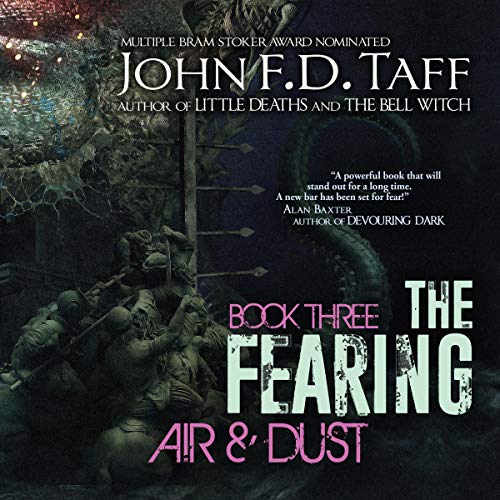 There are rumours of an encroaching darkness. A wall of sheer black spreading across the globe.
At the end of the book a man arrives with a convoy of people he has “saved” from other places. He tries to take over leadership of the army base and succeeds, but in doing so becomes the new villain of the story (god it’s hard to explain a story without spoiling anything). I’ll say this. By the time book three closes you’ll hate him in your bones. You’ll feel it in your gut. His name is Tim Jacoby and you’ll wish you were there so you could grab a weapon and reap vengeance yourself.
As with my previous reviews, hats off to the narrator, Linda Jones.
Book Four – Earth and Ember
The darkness is closing in. The psychotic new leader, Tim Jacoby, has had a message from God; Thou shalt go to Memphis.
So there he leads the last people alive on Earth. Graceland becomes their temporary home. The last stop before the final confrontation with Adam.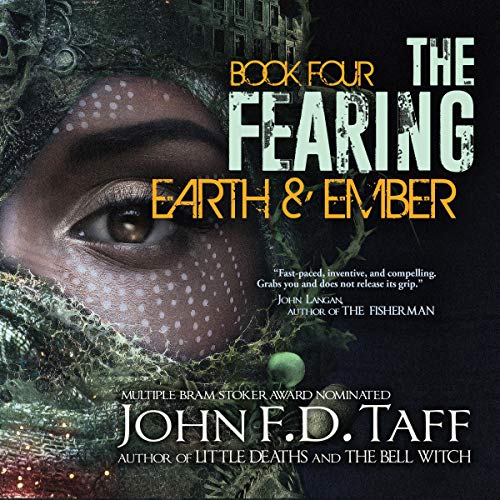
We find out what is up with Jelnik; Adam’s personal slave. We go back to Jelnik’s childhood. The events described are awful, harrowing and terrifying. After the flashback, Adam assures Jelnik that things could have been so much worse, if he only he knew. Jelnik doesn’t believe it. Adam shows him.
At this point I thought, “There’s no way Taff can make that scene worse unless he goes over-the-top-corny with it.” Scary stuff can fall into absurdity very easily and lose its impact. It’s a fine balancing act.
So the memory restarts. Adam has turned up the fear. And… it… is… glorious. There are no limits to Taff’s disturbed mind. And god it’s fun to watch.
The last survivors leave Graceland to make their way to the last city on Earth to face down Adam.
Monday’s role in the apocalypse is revealed.
Rev Mark and Adam face off.
The ending is neither rushed nor prolonged.
Linda Jones’s narration was, as always, perfect.
A note on the serialization
I really have nothing bad to say about the story, the author, the narrator, the characters, the writing itself, it’s all great. But I do have something to say about the release of the book. It won’t affect the star rating, but I think it needs to be said, if only because I want to recommend the book to as many people as possible but find that I can’t because I’d be asking them to invest too much money in my recommendation. The price is far far too high. (If the Kindle and paperback editions are priced to reflect the shortness of each instalment, then that’s fine. All good and well. Serialization makes sense in those mediums. This is purely to do with the Audible release.)
I understand the reason for releasing it in a serialised form (in the tradition of Stephen King’s Green Mile, and the works of Dickens, and Sir Arthur Conan Doyle etc.) But the reasons, in this instant, are driven by greed. A reason that rarely succeeds. The cost is too high. Each book is only about 3 hours long (apart from the fourth instalment which is just over 5) and most people only get one credit per month on Audible so he’s asking his readers to spend four months of credits on one story. That’s not much listening for a full third of a year. Especially when you can get seventy two hours of Sherlock Holmes for the same credit, and indeed The Green Mile in its entirety – 14 hours. I suspect it will ultimately have the opposite effect on sales and people will be put off by the combined high price. It won’t matter how much I, or other reviewers who have been lucky enough to get a review copy for free, rave about how great it is (and it is indeed great), the money grab leaves a bad taste in the mouth.
This is a book that should be loved by many more people than will be willing to part with the high ticket price. It would be sad to see the best horror I’ve read this year die because of an ill-considered route to market.
The book is being sold as an epic. And yet all four books combined are only the length of a single novel. It’s money for old rope. It frustrates me because if I hadn’t had the opportunity to review it for free I would have never gambled the £45.83 it would cost me (based on the current prices on Audible) to read it. It would have never happened.
I could get the stand for half the price (or one credit which is even cheaper) and it’s 47 hours long.
These things must be considered when it comes to releasing things in audio.
All four parts should be gathered together and released as The Fearing. I believe it would be a cornerstone of modern horror and many more people will discover it. People that really want to read it but can’t afford the comparatively massive cost would give it a go.
I would be the first to go to social media and tell the world about it.
It is a great book. One of my favourite of the last few years. If it wasn’t for that it wouldn’t frustrate me so much. I want the world to read it.
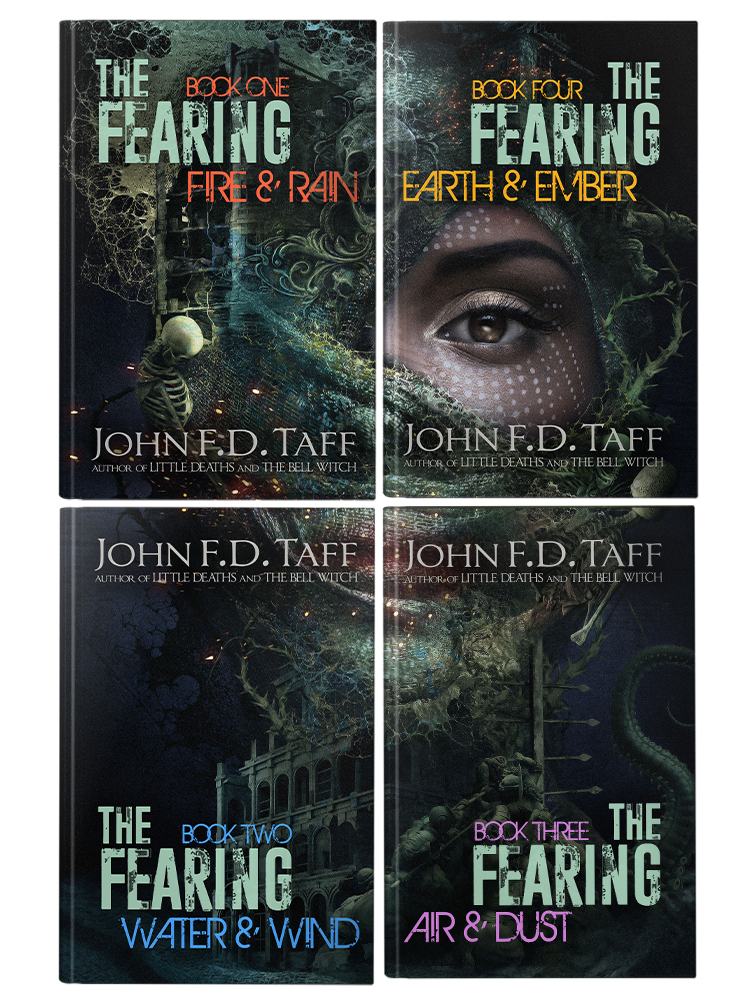
The one good thing about getting all four paperback editions is that the covers combine to create one big picture, which is pretty cool.
2A1J Episode 3 – Writing to Jazz
I this episode of the Two Authors One Journal podcast (aka 2A1J) Rachel says something interesting about Charles Dickens’ secret other success, Andrew plays the harmonica (badly), and they discuss the benefits of writing with the music on.
We find out what music Stephen King and Douglas Adams listened to while they wrote and what me and Rachel are listening to while we write our novellas.
On the novella front, meet the protagonist of Call Me Oedipus (the working title for Andrew’s novella), and Rachel reveals the title for her Murder Mystery.
Listeners Questions has a new jingle! But it might change next week… It might change every week.
Find us on Twitter @2A1Jpod for updates, and be the first to hear about new episodes by heading over to 2A1J.wordpress.com and signing up as a member.
You can follow Rachel on Instagram and Twitter @RachyPetalFace
And Andrew can be stalked @AndyChapWriter on Twitter, Instagram, and Facebook.
I’m back…

I couldn’t afford the next yearly payment for the andychapwriter.com domain name so I haven’t had access to my own site for a while. Finally things have reverted to andychapwriter.wordpress.com and I’m back in. In the new year I will pay for the domain again but for now we are slumming it.
So what’s been happening, I hear you ask? But of course you’re not asking that because you’ve probably never been here before. I’m going to tell you anyway. Much has changed. I won’t tell you about the awesome life changes that have happened. The woman who has changed everything. A move into the home of my dreams (if you are imagining a mansion you are on the wrong path. If you are imaging bookshelves stuffed with books, a globe bar, brown leather seats, a writing desk, then you are on the right track).
This is a website about my writing, so let’s talk about that instead. This woman I mentioned earlier, she’s the catalyst. She’s a writer too. We sit there, both of us, at night, she has a coffee, I have a glass of wine, and we write. Side by side. When we are done with our evening’s writing we read it to each other. And then we high-five and dance around laughing and shouting things like, “We are so fucking great!” and “This is going to change literature forever!” and then we cry because we are afraid that we might be just a bit too great. Genius s a burden, dear reader.
There has been a big change in my writing. My first two books were 40,000 word novellas. They were comedies. That’s what came out naturally. The books were well received and praised for their effortless humour (I’m in a bragging mood), and so I did what any good author would do when he’s on to something, I completely turned my back on it and started writing horror.
It’s my first attempt at writing a full length novel and it is flying out of me. I’ve never had so much fun writing. Those previous two books took well over a year to complete, in fact it was closer to two years. I started my current novel in September and am already at 35,000 words. And, if I can credit myself with some objectivity, they’re pretty good words too. The characters are strong, the story is good, the fear is working. I discovered that making someone laugh, and making someone afraid, are very closely related.
I haven’t just opened a word file and thought, what can I write that will really scare someone? I had an idea. It was to do with an old game’s console. I won’t go into what the story is about, not yet, but it is set in 2002 and is connected to events that happened in 1992. It has given me a chance to play with my own nostalgia in the writing. The characters took over the book completely. I barely have to write them, they are real and alive.
I know how the book ends but I don’t know exactly what’s happening from here to there. I’m halfway through. The story seems to know where it’s going. The characters seem to know for sure. It’s not like making something up. It’s more like excavating a story that’s already there. It’s like an archaeological dig. It is revealing itself one careful brush stroke at a time.
This post is getting a bit long. I will write more, the more I write. I’ll tell you about my partner and her book. I will reveal more about my own. Until then, farewell!
 Andrew Chapman / Author and Screenwriter