5am is a good time to write. Blue Pulp is getting exciting. The western is an underestimated genre. When you strip everything out, all the things that distract us in the modern world, so all you have is the man and his thoughts, you can get deep and frightening with the human condition.
I know you can’t buy any of these books yet but soon you’ll be able to. This is book three and I’ve got one more to write. I think I’ll be done by spring.
I was reading a western last night. A slim novella. Less that 200 pages. There is something engaging and lively in the telling of a shorter novel. Something I embrace in my own writing.
I can wait for you to read this. If you’ve never read a western before maybe it’s time to try it out.
I’ll be posting covers and release dates right here over the next few months.
When I was a kid, I could fly. I remember this very clearly. It wasn’t how you imagine it, not like Superman, but if I placed my foot just right, I could step onto the air.
Gradually I was able to move forward. The sensation was not like I was zooming down the street but that I was still and the houses were moving past me. I could travel far and wide in this way at speeds that would make an astronaut sick.
This memory is as clear and as real as when I learned to ride a bike, or the first time I fell off a skateboard.
Of course really it was just a recurring dream, I wasn’t actually able to fly, I think, but I’ve always had difficulties keeping the dreaming world out of the real world.
There are two ways to go with this problem. Your can either spiral into madness or become an author. Writing, after all, is nothing more than applied daydreaming.
That harnessed flight of fancy has been tamed over the years, chained to the page by grammar and story structure. it has now been enclosed in a paperback which you can purchase, if you wish.
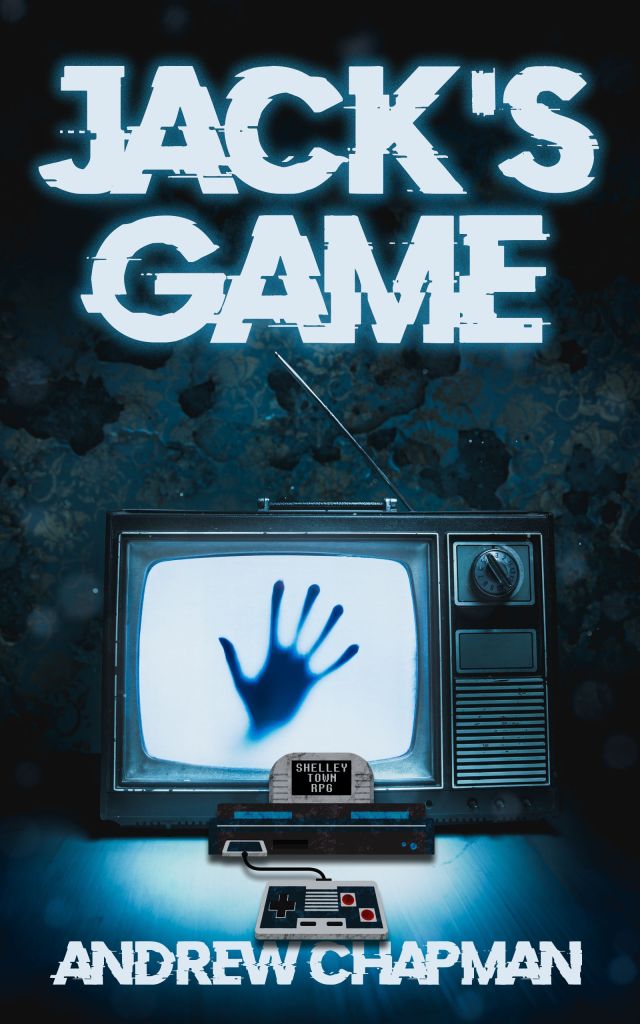
Jack’s Game is more than a novel. It is the culmination of years of keeping my feet on the ground and my dreams on the page.
I have been stuck on Chapter 27 of Hell’s Ridge since the 16th November!
I’ve just looked back at my Instagram posts and saw that, on the 16th, I wrote, “Stupid chapter 27. I’ve been looking at your for nearly forty minutes now”. Well, that forty minutes turned into a month.
900 words in a month. It has never taken me that long. But, I finally broke through. I got it down and the floodgates have reopened. It was that 20,000 word hurdle.
I wrote a short story last week so I haven’t been unable to write, it was just that bloody chapter 27. When you come to read it, and you get to that chapter, you ‘ll wonder what all the fuss was about.
Now I’m back on track and ready to finally get this thing finished. Only 15k to go.
Sometimes writing is just hard. Every word is like hefting a lump of marble onto the page. For me, the rewrite is my enemy. What’s the hardest part of writing for you?
If you are looking for tips to improve your writing you will find them here. But you will also discover that doing whatever the hell you want can work just as well too.
Gertrude Stein, the famous American novelist, poet, and playwright said –
Punctuation is necessary only for the feeble minded.
Before we venture into the spiralling madness of authors who go against the rules, I just discovered that the word “playwright” is written P L A Y W R I G H T . I assumed it would be spelled P L A Y W R I T E . Like someone who writes plays. Playwrite. This might be because I am a fool. It might also be because the English language is endlessly surprising. Etymologically speaking Playwright is similar to wheelwright. A wheelwright was someone who wrought wheels out of wood and iron. And so a playwright is someone who has wrought words into a dramatic form. Like the words have been hammered and bent into submission.
But this isn’t about playwrights. This is about rules god damn it, so let’s get to it.
There are hundreds of books about the rules of writing correctly. As authors we walk a tightrope of good grammar. At any moment we could fall into a pit of dangling participles, passive sentences, repetition, the much feared adverb that reveals the writers inability to show instead of tell, repetition, a misplaced comma, and god forbid; a rogue semi colon. And worst of all, repetition.
But how important are these rules and how much are they going to actually hinder your success?
Rule one
Only ever use he said or she said, and never follow it up with an adverb.
You don’t even need to use he asked, or she replied. He said is a tag to notify the reader who has spoken. They become invisible to the reader. We scan over them as we read.
Of course you can say, said Graham, or Susan said, but be warned; only do that if you have characters named Graham or Susan. If not, I would recommend using the names of your own characters. The key here is economy of words, and clarity. The reader wants to know who is speaking but nothing more. All the dramatic work should be done in the dialogue or the surrounding prose.
You might have a character at the breakfast table. His wife has prepared breakfast for him. And we get the following piece of dialogue. “I wanted my eggs runny, not raw,” said Graham, angrily.
Instead of using the word angrily, you would write something like, “I wanted my eggs runny, not raw,” said Graham, picking up his plate and throwing it at Susan.
You see, we have a vivid image, instead of “angrily”. There is no doubt that replacing the adverb is better.
Unless of course, you are one of the bestselling authors of all time.
Stephen King said about J. K. Rowling –
Ms Rowling seems to have never met an adverb she didn’t like.
It’s true. Her prose is littered with them.
I’m a sucker for this rule and I try to never use adverbs. But maybe I shouldn’t be afraid of throwing a few in every now and then. It hasn’t exactly hindered the success of Harry Potter.
Exclamation marks!
Avoid them. If you have more than three exclamation marks in your entire novel you have too many. It is lazy. It doing work that should be self-evident in the words being spoken, or the events that are unfolding. If you need to add a nudge at the end of sentence to let the reader know that THIS BIT IS REALLY SURPRISING then something is wrong.
Your words should speak for themselves without the fanfare to highlight how loud someone is shouting or that an explosion is really big. And just on an aesthetic level it makes the page look cluttered and messy.
Having said that, in Joe Hill’s hugely successful book, NOS4A2, there is an exclamation mark every time Charlie Manx, the bad guy in the story, speaks.
You will also find an excessive use of exclamation marks in the books of Tom Wolfe, F Scott Fitzgerald, Jane Austin, and of course the biggest offender of all, James Joyce.
Some people think of those authors as being amongst the best literary writers in history. So maybe using more than three in a book won’t be so bad.
Speech Marks
Here’s a curious one; when writing dialogue should you use the double quotation mark or the single one? That has a straightforward answer.
The publishing standard in the UK is to use a single quotation mark. And in the US, they use the double quotation mark.
Unless of course you’re the bestselling author Roddy Doyle, who uses neither. He just starts each piece of dialogue with a dash.
Cormac McCarthy, author of No Country for Old Men, and The Road, didn’t believe in speech marks either, saying –
I believe in periods, in capitals, in the occasional comma, and that’s it.
On the subject of basic punctuation, in the last twenty-four thousand words of James Joyce’s Ulysses there are only two full stops and one comma.
So what’s the point of all this? Well, simply, there is no right or wrong way to write well. You can do whatever the hell you like. The books that break through and become huge bestsellers are littered with broken rules. Nobody in the publishing industry can predict what makes a book become a bestseller. Writers have tried to hone their craft with best practices but, ultimately it’s for nothing.
My advice is that you should learn and understand all these things and then use them at your discretion. Be free to write the way you want to write.
Maybe you don’t need to polish your prose into a smooth perfectly formed generic thriller. Let it be a bit rugged around the edges. Let a bit of your voice come through.
Writing is like music. You can release a highly produced pop song that does well in the charts, and you will do well. For me, those songs are polished so smooth I bounce right off.
Or you can be like Bob Dylan. Sometimes he would screw up a word while singing and just say the word again. He didn’t even go back and rerecord it. It’s right there in the song. He might screw up twenty seconds in and just start eh song again, and it’s right there in the album. It’s those cracks in the perfection that let us in. It’s true for all art, and it’s especially true for writing.
That’s all from me!
To get notifications for new videos from me click subscribe and ring that notification bell. New videos come out every Wednesday.
If you are an author and you have a mailing list why not pop a link to my channel in your next newsletter. And if you do please let me know and I will plug your book in a future episode.
TikTok is a social media app that mostly involves lip syncing teenagers and dance routines. It is not a place for literature… Seems like the perfect place to chisel out a niche.
If you are unfamiliar with the format, here are the basics:
There are three ways to post content; a 15 second video, a 60 second video, or a photo montage.
You can easily add special effects and filters. You are limited to 100 characters in your description, which must include your hashtags.
You film your short video, post it, and with any luck you start to amass likes and followers.
I am new to TikTok but I thought it might be interesting to share any insights and tips that I glean along the way.
Here is the first TikTok I made with my manifesto –
It is important as authors that we experiment with different ways of reaching and interacting with readers. This TikTok thing might crash and burn, but it might not. Either way I’ll be doing weekly updates with stats right here on my blog. So please follow me if you are curious about how this goes. Maybe you’ll decide to take to TikTok too, in which case you must let me know; we’ll do a duet.
I’ll get into TikTok duets in another post but, should I gain momentum, a duet is a way of giving new TikTokers an introduction to like minded followers. We’ll grow together.
The link below will take you straight to my TikTok profile. Feel free to cringe at my early attempts at content. Eesh. It’s a learning process, right? And don’t forget to press that follow button!
So, I’ve been on TikTok for three days so far. At the bottom of each TikTok update on this site I’ll publish my stats so you can see my growth and decide if it would be a worthwhile venture for yourself.
I’ll share my failed posts, my successful ones, everything; the good and the bad. Things are going to get experimental and weird. Until next time.
In episode two of the 2A1J Podcast Andy and Rachel are very sick. But they persevere against adversity to bring you another brilliant, thrilling, funny, and all-round okay podcast.
We talk about the progress of our novellas, we answer listener questions, talk about moths and Blackadder, and generally make each other laugh.
This book surprised me. I was expecting some schlock. Some B-movie pulp horror. A first attempt at fiction by an author who would become one of England’s best selling horror novelists. But actually, it was brilliant.
It has a few intentional false starts so you’re not sure for a while if the person you’re following on that page is going to die in the next. Or if he, or she, will go on to be the main protagonist of the story. At first the book is a series of vignettes of rat killings. But you don’t just get a violent attack. You really get to know every character before they are ripped to shreds.
It starts with a story involving a gay salesman struggling with his love for another man. You think he’s going to be the main character and then he wakes up to find he’s being eaten alive by a swarm of rats the size of a small dogs.
The depth James Herbert gets from his characters is impressive for such a small book. He wants you to feel something for them before their eyes are graphically chewed out.
There are lots of things about this book I want to spoil for you, but I won’t. The ending was absurd and brilliant. I absolutely recommend it.




 Andrew Chapman / Author and Screenwriter